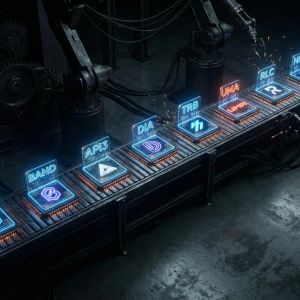
BitcoinWorld SEC Approves Revolutionary Nasdaq Rule for Tokenized Stock Settlement In a landmark decision for financial markets, the U.S. Securities and Exchange Commission (SEC) has officially approved a pivotal Nasdaq rule change, clearing the path for the tokenized settlement of traditional securities. This groundbreaking move, reported by Wu Blockchain on April 10, 2025, authorizes a pilot program that could fundamentally reshape post-trade infrastructure. Consequently, the approval signals a major regulatory step toward integrating blockchain technology into the core of U.S. capital markets. SEC Approves Nasdaq’s Tokenized Settlement Framework The SEC’s approval centers on a Nasdaq-proposed amendment to its rules, specifically enabling the Depository Trust Company (DTC) to settle certain equity securities in a tokenized form. This initiative, known as the DTC tokenization pilot program, allows qualified broker-dealers and institutional participants to opt for blockchain-based settlement. Participants can activate this feature simply by setting a specific order flag on eligible trades. Importantly, the design ensures market integrity remains paramount. Tokenized shares and their traditional counterparts will coexist within the same consolidated order book. Furthermore, they will receive identical execution priority, preventing any market fragmentation or unfair advantage. The pilot program will commence with a carefully selected basket of assets. Initially, the scope includes constituents of the Russell 1000 Index, which represents the top 1,000 publicly traded companies in the U.S. by market capitalization. Additionally, the program will incorporate a selection of major exchange-traded funds (ETFs) that track significant indexes. This phased approach allows regulators and market operators to monitor performance, assess risks, and evaluate scalability within a controlled environment before potential expansion. The Mechanics and Context of the DTC Tokenization Pilot Tokenization, in this context, refers to the process of creating a digital representation of a traditional security on a distributed ledger. Each tokenized share is a digital asset that corresponds directly to a traditional share held in custody. The DTC, the national clearinghouse for U.S. securities, will act as the issuer and custodian for these digital tokens. This structure leverages blockchain’s potential for near-instantaneous settlement, often called T+0, while maintaining the trusted, centralized role of the DTC. The move follows years of industry experimentation and regulatory consultation. For instance, projects like the Australian Securities Exchange’s now-canceled blockchain overhaul and various European trials have provided valuable lessons. The U.S. approach, however, is distinct in its focus on integrating new technology directly into the existing, highly regulated framework of a national market utility. Expert Analysis on Market Impact and Regulatory Signals Market analysts and legal experts view this approval as a significant, albeit cautious, signal from the SEC. “This is not an endorsement of cryptocurrency speculation,” notes a former SEC official familiar with the proposal. “Instead, it’s a targeted experiment in applying distributed ledger technology to solve specific inefficiencies in settlement and record-keeping.” The potential impacts are multifaceted. Primarily, tokenized settlement could drastically reduce counterparty risk and capital requirements for brokers by shortening the settlement cycle. It may also enhance transparency through an immutable audit trail of ownership. However, experts caution that the pilot is a test. Key challenges around interoperability, cybersecurity, and legal finality of transactions on-chain remain active areas of focus. The table below outlines the core differences between traditional and tokenized settlement under this pilot. Aspect Traditional Settlement (T+2) Tokenized Pilot Settlement Settlement Time Two business days (T+2) Potential for same-day or instantaneous (T+0/T+0.5) Record-Keeping Centralized database at DTC Distributed ledger with DTC as issuer Asset Form Electronic book-entry Digital token representing book-entry Market Access Standard equity market Same order book, optional tokenized settlement Simultaneously, this development occurs within a broader global trend of financial market digitization. Jurisdictions like Switzerland, Singapore, and the European Union are advancing their own digital asset frameworks. The SEC’s action, therefore, positions U.S. markets to remain competitive. It provides a regulated sandbox for American financial institutions to develop expertise in digital asset infrastructure. Ultimately, the data gathered from this pilot will inform future policy decisions and could pave the way for more widespread adoption of blockchain in mainstream finance. Conclusion The SEC’s approval of Nasdaq’s tokenized settlement rule marks a historic inflection point for traditional finance. By sanctioning a real-world pilot within the existing market structure, regulators have opened a controlled pathway for blockchain innovation. The success of this DTC tokenization program will hinge on its ability to demonstrate enhanced efficiency, resilience, and security. If proven, this model could gradually transform the foundational plumbing of global securities markets, making the vision of instantaneous, transparent settlement a tangible reality. The focus now shifts to the operational rollout and the valuable data it will generate for the future of finance. FAQs Q1: What does “tokenized settlement” mean in this context? Tokenized settlement refers to the process of clearing and settling a trade by representing the ownership of a traditional security (like a stock) as a digital token on a blockchain. The token is a digital certificate of ownership issued and backed by the Depository Trust Company (DTC). Q2: Can retail investors participate in the tokenized settlement pilot? No, initially the pilot program is designed for qualified institutional participants and broker-dealers. It is a test within the wholesale market infrastructure. Retail investors would continue to trade and settle through their brokers as usual, potentially benefiting from downstream efficiencies. Q3: Does this mean stocks will become cryptocurrencies? No. The pilot involves creating a digital representation of existing, regulated securities on a permissioned blockchain. These are not new, volatile crypto assets. They are digital tokens that mirror the value and rights of the underlying Russell 1000 stocks and ETFs, issued by the trusted central securities depository (DTC). Q4: How does this affect the current two-day settlement cycle (T+2)? The technology enables the potential for much faster settlement, possibly same-day or instantaneous (T+0). However, the pilot will first test the functionality and reliability. A full transition away from T+2 would require further regulatory rulemaking and industry-wide implementation based on the pilot’s results. Q5: What are the main risks the SEC is trying to assess with this pilot? The SEC and market operators will closely monitor several risks, including: the technological resilience and security of the blockchain system, the clarity of legal ownership and finality of tokenized transactions, operational integration with legacy systems, and the management of any novel cybersecurity threats specific to the digital asset infrastructure. This post SEC Approves Revolutionary Nasdaq Rule for Tokenized Stock Settlement first appeared on BitcoinWorld .