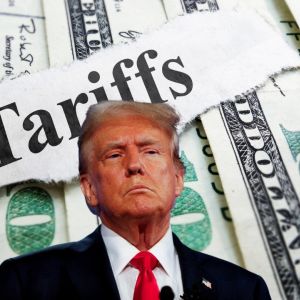
President Donald Trump’s now-voided tariffs have left an estimated $8.2 billion worth of imported goods tangled in the legal hothouse after a U.S. Supreme Court finding that a key component of his trade policy was unlawful. The court threw out the tariffs, however U.S. Customs and Border Protection (CBP) has not updated the systems it relies on to comply with the judgment. Despite the Supreme Court striking down Trump’s duties, the administration maintains that its trade policy hasn’t budged and has added a new 15% global tariff . Yet the court has said the president lacks the legal authority to impose comprehensive import tariffs. Starting in early 2018, Trump deployed IEEPA to impose what he describes as “reciprocal” tariffs. This included a 10% duty on the bulk of imports, with higher rates for items from China, Canada and Mexico. The steps were critical to counter trade deficits and supply chain risks, the administration said. Over the years, the duties generated billions of dollars in payments from importers. The duties were embedded directly into CBP’s electronic systems, among them the cargo-tracking and tariff-classification tools deployed at ports of entry across the country. But when the Supreme Court determined that IEEPA does not give the president authority to place tariffs, it effectively erased the legal basis for those duties. Importers face delays, extra costs, and confusion The immediate, costly consequences for businesses are: importers fear some shipments are delayed, are being charged duties that may no longer be valid, or are being flagged for review simply because the system hasn’t been able to keep up with the court’s decision. Several businesses have begun lodging formal protests and corrections of entry with Customs to protect their rights . Others are waiting for updates in the tariff codes so they can move their goods through. If the U.S. CBP cannot act quickly, trade bodies say, supply chains could see longer delays in getting products to their destinations, higher storage fees, and late deliveries. Governments sometimes have to invest time and adjust their technology and systems when courts invalidate major schemes. The automated systems continue to apply tariffs that the Supreme Court has deemed unlawful. Companies that have already paid tariffs now worry about whether they should get their money back—and how. White House moves to new tariff authority Trump promptly took action following the ruling, announcing a 15% global duty under Section 122 of the Trade Act of 1974. This law gives the president the authority to impose temporary tariffs to alleviate balance-of-payments problems. Section 122 is time-limited, unlike the IEEPA-based tariffs. It can remain in place for up to 150 days unless Congress ratifies an extension. But legal experts say that Section 122 was crafted for narrower economic circumstances and would likely not align fully with the administration’s sweeping trade policies. Analysts are also concerned that the new tariff could be challenged in court, further adding to the uncertainty. The court’s ruling isn’t confined to the United States. Europe, Africa and Asia are other nations watching too, not far behind. Meanwhile, companies that used the old tariff system to ship goods are unsure whether they will have to pay duties, be eligible for refunds, or face further policy changes. While such concerns remain, the most pressing pressure point is still at U.S. ports. Containers worth billions of dollars are trapped in a legal grey area. And until Customs overhauls its systems and provides clear explanations of refunds and classifications, businesses will have to navigate a confusing, costly transition. Get seen where it counts. Advertise in Cryptopolitan Research and reach crypto’s sharpest investors and builders.